Is the Changing Hurricane Threat Overblown?
In an article published in 2018, Bjorn Lomborg wrote that "claims of ever worse hurricanes are wrong." Lomborg went on to point out that there has been no substantial change in hurricane frequency—that is, we are not seeing any more hurricanes today, as compared to the long-term average—and that the rise in hurricane losses is related to the rapid growth and development in coastal areas.
And here's the thing—on those last two points, he's right.
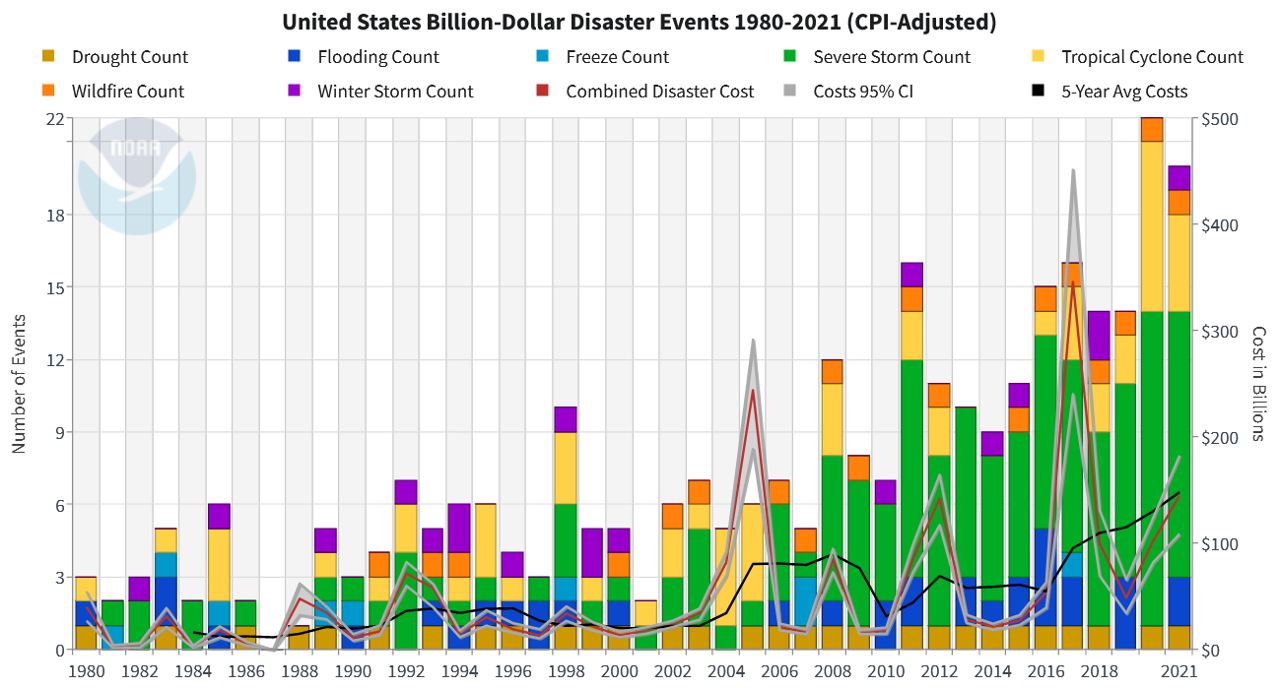
There's been a huge increase in billion-dollar disasters. Adam Smith writes that the "increase in population and material wealth over the last several decades, are an important cause for the rising costs," and "these trends are further complicated by the fact that much of the growth has taken place in vulnerable areas like coasts." There's no question that development in high-risk areas is contributing to higher losses.
The history of billion-dollar disasters, adjusted for inflation (NOAA/NCEI)
As to the question of hurricane frequency, a team that published a paper in Nature Communications a few years ago concluded by saying "we find here that, once we include a correction for undercounts in the
pre-satellite era... there are no
significant increases in either basin-wide [hurricane] or [major hurricane] frequency, or in the [major hurricane to hurricane] ratio for the Atlantic basin between 1878 and 2019."
US landfalls (top) and North Atlantic basin totals (bottom), for hurricanes (left) and major hurricanes (right) (Vecchi 2019)

The findings of that 2019 paper were echoed by the Intergovernmental Panel on Climate Change (IPCC) in it's most recent report, published in 2021. The IPCC wrote that "there is low confidence in the long-term (multi-decadal to centennial) trends in the frequency of all-category tropical cyclones."
So Lomborg's contentions, that there aren't any more hurricanes, and that the increase in hurricane damage is largely a reflection of rapid coastal development, are correct. But let's also look at his more sweeping conclusion, that hurricanes aren't getting worse. That's a big statement, and particularly in light of the many other findings specifically related to tropical cyclones in the recent IPCC report:
"In summary, there is mounting evidence that a variety of [tropical cyclone] characteristics have changed over various time periods. It is likely that the global proportion of Category 3–5 tropical cyclone instances and the frequency of rapid intensification events have increased globally over the past 40 years. It is likely that [tropical cyclone] speed has slowed over the USA since 1900."
In their synthesis report, a collection of what teams of renowned experts believe to be the best available science today, the IPCC is saying that more of the storms are high-end hurricanes, that they are getting stronger more quickly, and that they are slowing down—which can greatly amplify the impacts. In recent years, there have been many examples of tropical cyclones exhibiting these characteristics.
There have been some truly shocking storms over the last decade. As one of the two strongest tropical cyclones at landfall on record, 2013's Super Typhoon Haiyan is certainly among that group. The images below compare the satellite presentation of Hurricane Katrina, on the right—and we all know precisely how bad that storm was—with the extraordinary size and intensity of Haiyan, on the left. It's like night and day.
Super Typhoon Haiyan, superimposed on the Gulf of Mexico, vs. Hurricane Katrina (Rick Kohrs, SSEC, CIMSS satellite blog)

Many of us in the meteorological community were taken aback by this breathtaking infrared image, showing a satellite presentation that is unrivaled among tropical cyclones. Haiyan produced tornado-like damage over an enormous swath of the Philippines, killing over 6,000, and displacing 6,000,000.
Super Typhoon Haiyan just before landfall, from Suomi-NPP (Dan Lindsey, CIRA/RAMMB)

The changing nature of the hurricane threat is like so many issues today—it's complicated. We don't appear to be getting more hurricanes, and we can all be thankful for that. There is indeed ever more population and property at risk, and that's certainly a key driver of higher damage losses. But we should be very careful about using only those two sets of circumstances to characterize the threat from hurricanes.
These storms derive their power from warm ocean waters. Many things in the atmosphere have to be optimal to develop a high-end hurricane, but all of those other factors being equal, if there is more energy available in the oceans, there is more potential intensity for hurricanes. From a purely physical standpoint, hurricanes should be getting stronger. For those on the coast, hurricane resilience should be a priority.


Comments
Post a Comment