Taking Matters Into Your Own Hands
On October 10th, 2018, Hurricane Michael became the fourth-strongest hurricane by wind speed to make landfall in the contiguous U.S. It was a category five storm, with sustained winds of 160 mph. Michael devastated Mexico Beach, and went on to wreak havoc in Panama City. 90% of the structures in Panama City were damaged. The storm may have displaced as many as 20,000 people. Winds gusted to 164 mph in Panama City, and the entire metro area was a sea of tangled structural and tree debris.
In the middle of all that wreckage, five homes stood out—defiantly, and almost inexplicably. They are modest, one-level homes that were built by Habitat for Humanity. They looked like they had been untouched by the storm, and for the most part, that was true. Among all five homes, the damage was limited to an A/C unit, some siding, and one window. It was a demonstration of what effective hurricane fortification looks like.
One of the five Habitat for Humanity homes, after Michael hit Panama City (IBHS)

The key to the success of these homes is a continuous wind-load path, with bolts and rods connecting the roof to the foundation (below). The roof is the most vulnerable part of a home in a hurricane. As wind drives into exterior walls, a lifting force builds underneath the eaves. Once part of the roof gives way, and the structure's envelope has been compromised, wind-driven rain begins to enter, vastly increasing the potential for significant damage or collapse. A continuous load path makes roof failure much less likely.
Schematic of the continuous wind-load path, from the roof, through the walls, to the foundation (IBHS)

Protection like this just one of the available routes in hurricane mitigation, which essentially means making homes more wind resistant. There's a wide array of options, and costs—from a couple hundred dollars to thousands—but substantial fortification doesn't have to be terribly expensive. In some areas, the level of protection in the Habitat for Humanity homes adds about 3-5% to the purchase price of new construction. When balanced against the hassle of major repairs, that premium might be seen as a small price to pay.
Insurers Under Pressure
Another issue is that years and years of underpriced wind insurance, coupled with growing hurricane losses, is creating serious headwinds in the insurance market. Six Florida insurance companies that offered wind policies have liquidated, and another three will liquidate this year. FedNat Insurance Company, of the largest in Florida, announced in May that they were planning to drop nearly 70,000 policies ahead of the 2022 hurricane season. Florida Farm Bureau insurance is looking to increase rates by nearly 50% this year.
Unfortunately there has long been a subsidization of rates in high-risk areas, encouraging risky development. In an optimal insurance pricing environment, insurance rates would send and important price signal to real estate markets, effectively limiting coastal development. Instead, "insurance rates are deliberately suppressed—often dramatically so—thus failing to alert private parties who purchase property insurance to the true risk of living dangerously." This has created massive risk distortion, which is now straining the system.
For homeowners, investing in hurricane mitigation measures can make insurance easier to obtain and retain. Florida law requires insurance premium discounts for installed mitigation, and in some high-risk areas, insurers require fortifications to write new policies. Mitigation also lessens the odds of disruption, in dealing with insurers and contractors, or being displaced for an extended period of time.
Mitigation Options
With a growing hurricane risk, and a looming insurance crisis, coastal homeowners should be taking a long look at hurricane mitigation. Unfortunately, research has shown that for the most part they are not. People tend to think that disasters happen to other people, so they usually don't voluntarily fortify their homes.
There are federal grant programs, including FEMA's Hazard Mitigation Grant Program (HGMP), which doled out $7 billion for retrofits from 2007 to 2016—but mostly in the wake of hurricane disasters. FEMA also has the Pre-Disaster Mitigation (PDM) grant program, but the PDM only spent about 7% of what the HMGP did over the same period. In general hurricane mitigation tends to be much more reactive than pro-active.
That's a shame, because many mitigation measures are reasonably priced, when weighed against the alternative. Retrofitting an existing home with hurricane clips (below) to strengthen the roof-wall connection, can cost around $1,000 for a 2,000 square-foot roof, the average size nationwide. The cost is even lower when the clips are owner-installed. The clips can be purchased for as little as $1 each, and fastened with a drill.
Hurricane clip connecting top plate to rafter (Structural Engineering Blog)
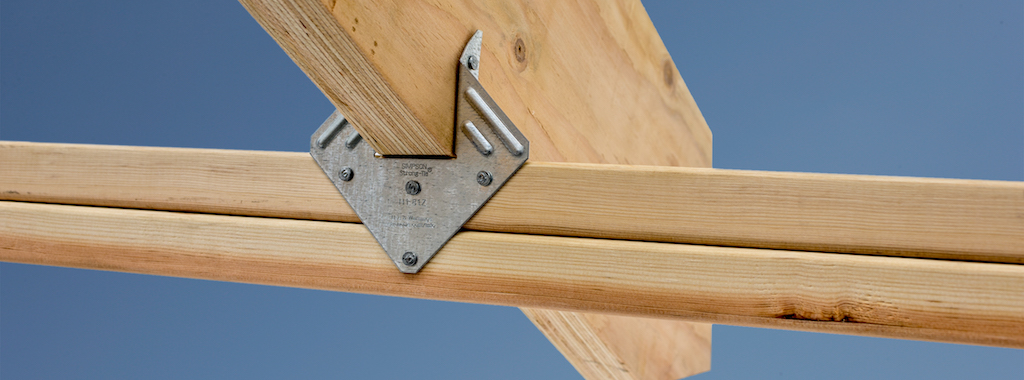
The non-profit Insurance Institute for Business & Home Safety (IBHS) has been researching mitigation for years, and they've developed three fortification standards. Fortified Roof is the base level, focused primarily on the roof-wall connection, and sealing any openings in roofs to prevent wind-driven water intrusion. The next level is Silver, which incorporates Fortified Roof requirements, and adds protections for a home's openings, including braces for the garage doors, and metal or polycarbonate (below) hurricane shutters for the windows. Gold is the highest level of protection, and in addition to the Silver requirements, it adds the continuous wind-load path.
Polycarbonate hurricane shutters are lightweight, and allow the light in (Shutter Shack Blog)

Perhaps the most important consideration for homeowners, as to whether they should invest in mitigation, is simply peace of mind. Those who are not on the immediate coast and/or in evacuation zones may prefer to stay home during a hurricane, and that option is more tenable in a fortified home. Whether people stay or not, or if they have a vacation or rental property, having a home that can put up a serious fight during a high-end hurricane can save a terrific amount of time, money, stress and emotional energy on the other end.
Interest in mitigation surges after hurricanes, when people understand just how difficult the recovery is. But there is another path, and it doesn't have to break the bank. In an era of meaner hurricanes, mitigation is a way to take matters into your own hands. It would allow millions "to enjoy the benefits of living, vacationing, and working along the coast, while still containing losses when a hurricane eventually strikes."


Comments
Post a Comment