The Lure (and Risk) of the Coast
My wife grew up near Juno Beach, Florida, in Palm Beach County, and we've been visiting the area for years. I never get tired of it. Though it's always growing, Juno still has a sleepy feel to it, with mostly uncrowded beaches (below) flanked by mangrove thickets. There are wonderful beach side parks, great little outdoor restaurants—and on most days there's a stiff breeze, driving an energetic blue and turquoise ocean.
.JPG)
All of which is to say, I get it, completely. There's no doubt that many of the nation's coastal areas are wonderful places to live. It's no surprise then, that 4 in 10 Americans live in coastal counties. While that share of people on the coast hasn't changed much over decades, our overall population has of course grown dramatically, and the total number of coastal residents has skyrocketed. Many coastal counties in the Southeast, and particularly in Florida, have seen populations double, triple or quadruple over the last four to five decades.
Percent Population Change in U.S. Counties, Highlighting Coastal Shoreline Counties, 1970-2010 (NOAA)

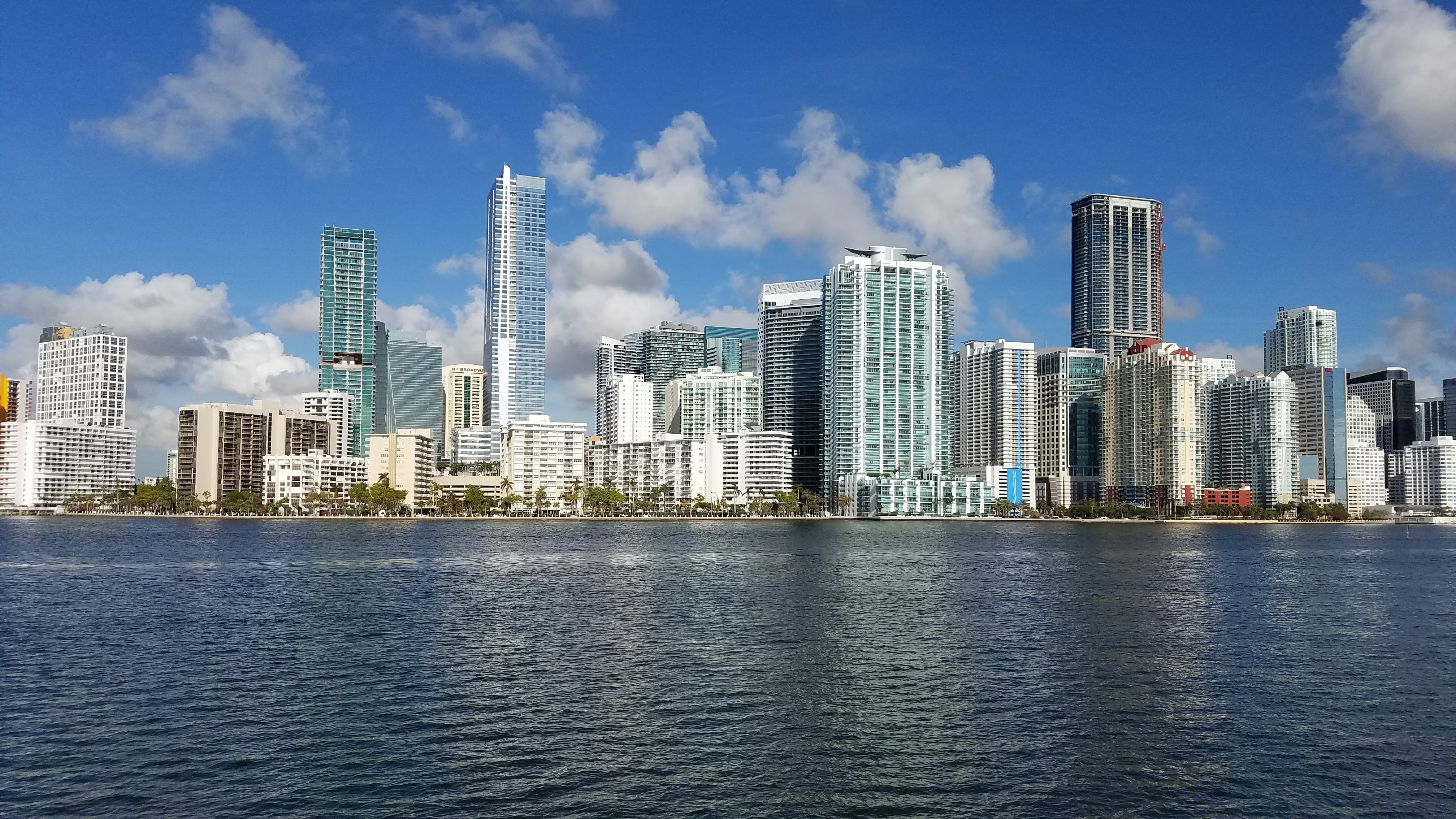
The result of this rapid growth is a very high population density in coastal counties—about six times that of the rest of the country. While Juno Beach is still not all that crowded, it's a very different story just to the south, and then all the way down to Miami. The population density in South Florida, seen as a bright concentration of light from orbit (below), rivals that of many of our most populated areas, including the I-95 corridor in the Northeast. Almost six million people live in South Florida, and much of the growth occurred over the last few decades.
Florida as seen from the International Space Station on October 13, 2014 (NASA)

It's likely that part of what fueled this extraordinary growth is a relative hurricane drought, which was particularly profound from the 1960s through the 1990s. This quieter period may have been caused by air pollution, or sulfate aerosols, which can block sunlight and limit the amount of energy available to hurricanes in the ocean. Dr. Kerry Emanuel has identified a substantial relationship between Atlantic Main Development Region (MDR) sea-surface temperatures and measure of the total energy produced by hurricanes (below).
From "On the Causes of the Late 20th Century North Atlantic Hurricane Drought" by Kerry Emanuel

While it's certainly good that our air quality has improved, that shift appears to have, along with the steady rise in ocean temperatures, ushered in a far more active era for hurricanes. We also know that there have been far more active periods in South Florida. From 1945 to 1950 there were five major hurricanes that affected the region. Five. A similar run of high-end storms today would be absolutely devastating for the area.
NOAA Historical Hurricane Tracks online tool

In South Florida, the long-term average periods of time between major hurricane strikes, known as return periods, is generally on the order of one to two decades (below). These averages were generated using data from 1886 to 2010. There is of course a great deal of variation in actual return periods, as the late 1940s demonstrate, but the upshot here is that it's only a matter of time before a major returns to South Florida.
Estimated return periods for hurricanes passing within 50 miles (NHC/NOAA)

All of these data points—explosive growth and high-density populations, fueled by decades of lower than average hurricane activity, along with the changing character of hurricanes, and rising seas to boot—indicate the potential for calamity. You'd think that policymakers would tap the brakes. But that hasn't been the case. "The reason why this development still continues is that people are making money on it," said Western Carolina University's Robert Young. "Communities are still increasing their tax base—and that's what politicians like."
Downtown Miami (/NOAA)
We've had some awfully close calls in recent years, including in particular Hurricane Dorian, which came within 100 miles of creating a historic, next-level catastrophe in South Florida—in that it was extremely intense and it stopped moving at it's closest point. Sooner or later, our luck will run out. When it does, the insurance industry and government relief funds will be under even greater pressure. Now more than ever, coastal residents should be thinking about taking a more pro-active approach to the hurricane threat.


Comments
Post a Comment